
scattering and stats
andrew.mccluskey at bristol dot ac dot uk
navigating physics, chemistry, mathematics, and scientific computing
The Hidden Cost of STFC Cuts
from: 2026-03-9 | Updated: 2026-03-14The future of UK research funding has been the subject of significant discussion in the past few months, driven by the transition to Prof. Sir Patrick Vallance’s buckets, an approach to simplify the research funding landscape and more easily relate funding to real-world impacts that can be communicated to the public. Included in this has been the announcement of substantial budget reductions for STFC (Science, Technology and Facilities Council), which operates the UK’s National Laboratories.
The announcement of these cuts has been met with concern from researchers in particle physics, astronomy and nuclear physics (known as PPAN), with open letters from early career researchers and the heads of university physics departments across the UK. Their concerns focus on how a decrease in the STFC budget will affect the PPAN research funded by STFC.
I want to offer a slightly different perspective: that of a researcher working outside PPAN whose research requires access to the UK’s National Laboratories. STFC’s facilities are used by researchers from across UK science, meaning these cuts would have far-reaching impacts that may be overlooked if we take a narrow view of STFC’s role.
Why is STFC “Unique”?
UKRI (UK Research and Innovation) is split into funding councils, which support different UK research disciplines. Materials science and chemistry research, for example, is supported by EPSRC (Engineering and Physical Sciences Research Council); it typically funds scientific research through “applicant-led” grants, covering salaries and consumables.
Prof. Sir Patrick Vallance has acknowledged that STFC is a bit of a different beast from the other councils1. STFC funds applicant-led research in PPAN, but unlike other funding councils2, STFC also operates and funds several laboratories and large-scale research facilities across the UK, including ISIS Neutron and Muon Source and Diamond Light Source, and is also responsible for the UK’s investment in international research collaborations such as the European Space Agency, CERN, and the European Spallation Source. While the other councils employ staff primarily focused on administering funding for research projects, the majority of STFC employees are scientists actively engaged in conducting world-leading research.
Operating large-scale facilities and engaging in international collaborations pose very different challenges from funding applicant-led research. This work requires long funding timescales, making it difficult to react to external economic challenges, including rising electricity costs in the UK3 and fluctuations in foreign exchange rates. It is these challenges that UKRI identified as the cause of the “unique situation at STFC”4.
How STFC Cuts Will Influence Other Councils
While there has been substantial pushback against the cuts to STFC from researchers who receive STFC applicant-led funding (i.e., those in PPAN), I have not seen this level of concern from those who benefit from STFC facilities.
I am not eligible to apply for STFC applicant-led grants; instead, as a researcher in the chemical sciences, I would be supported by EPSRC funding. Despite this, my research relies on STFC-operated or supported research facilities to conduct my science; I am a regular visitor to ISIS Neutron and Muon Source, Diamond Light Source, and in future the European Spallation Source. Without access to these world-leading facilities, my research would not be possible. I am not alone; the figure below shows that the vast majority of UKRI-funded research conducted at Diamond Light Source is not funded by STFC. Instead, EPSRC, BBSRC, and MRC make up over 90% of Diamond’s UKRI-funded activity.
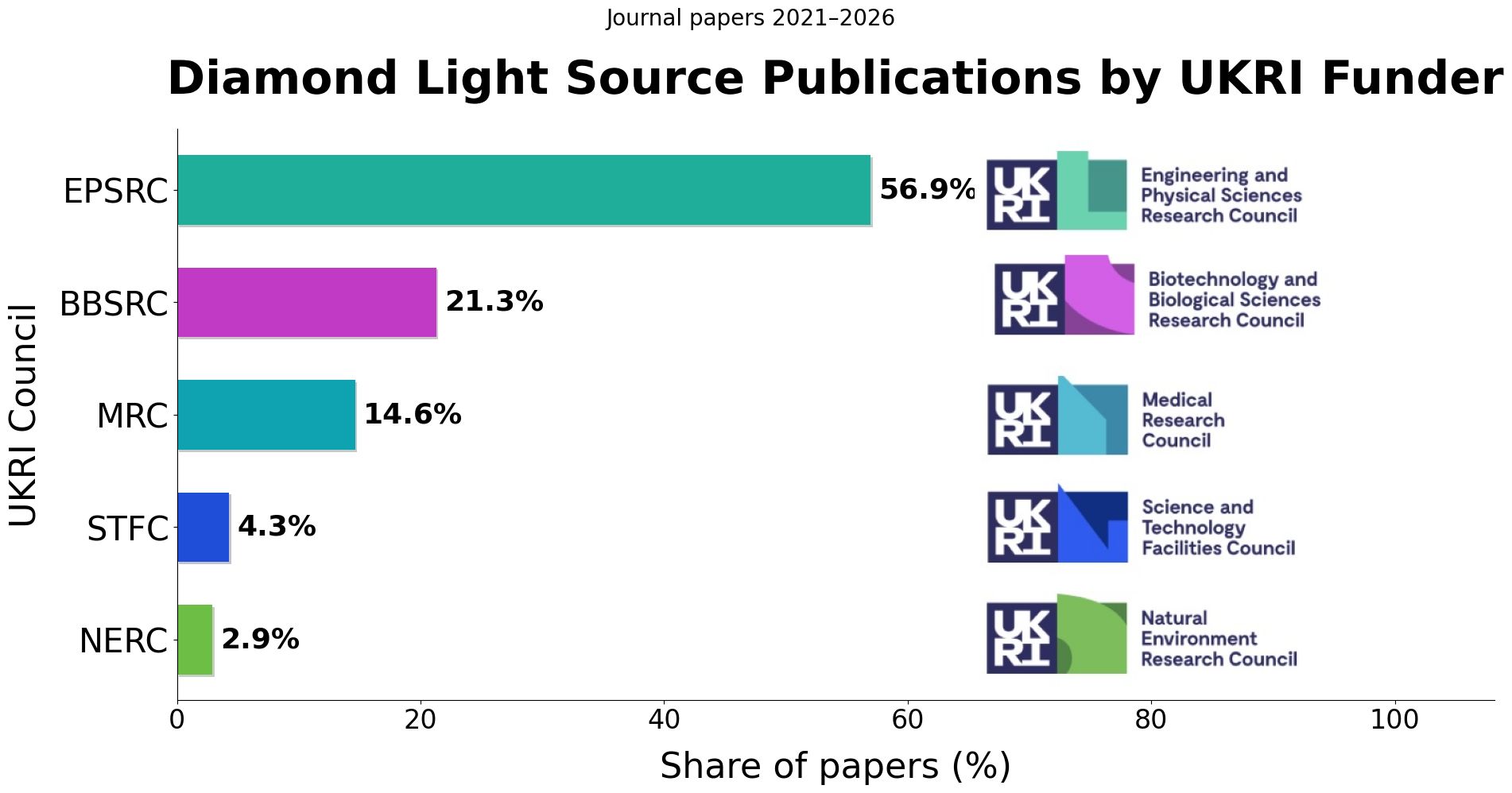
A breakdown of journal publications with funding from the UKRI research councils referenced in Diamond Light Source publications, from Alan Heavens LinkedIn post.
If we look at the list of STFC Facilities5, Diamond is not the only one that delivers non-“STFC science”. Cuts to facilities resulting from an STFC budget reduction will affect all areas of UK science. And currently, I worry that users of these facilities are not communicating how vital they are to the delivery of their research. If we do not make this case, we risk the government overlooking the facilities’ important role across UK science. Now is the time to make our case for their continued support.
-
Prof. Sir Patrick Vallance to the Science and Technology Committee on the 3rd March ↩
-
Until recently, the MRC (Medical Research Council) operated laboratories, but as of 2025, it has withdrawn funding from these. ↩
-
This presentation from 2011 puts electricity costs at 15% of the ISIS budget; I am sure that, given the increases in electricity costs across the UK, it is substantially higher now. ↩
-
Prof. Sir Ian Chapman in his open letter dated 1st February. ↩
-
I note that this does not include the ILL or the European Spallation Source; I’m not sure exactly why. ↩